You have one life, don't go through it without ever becoming yourself fully.
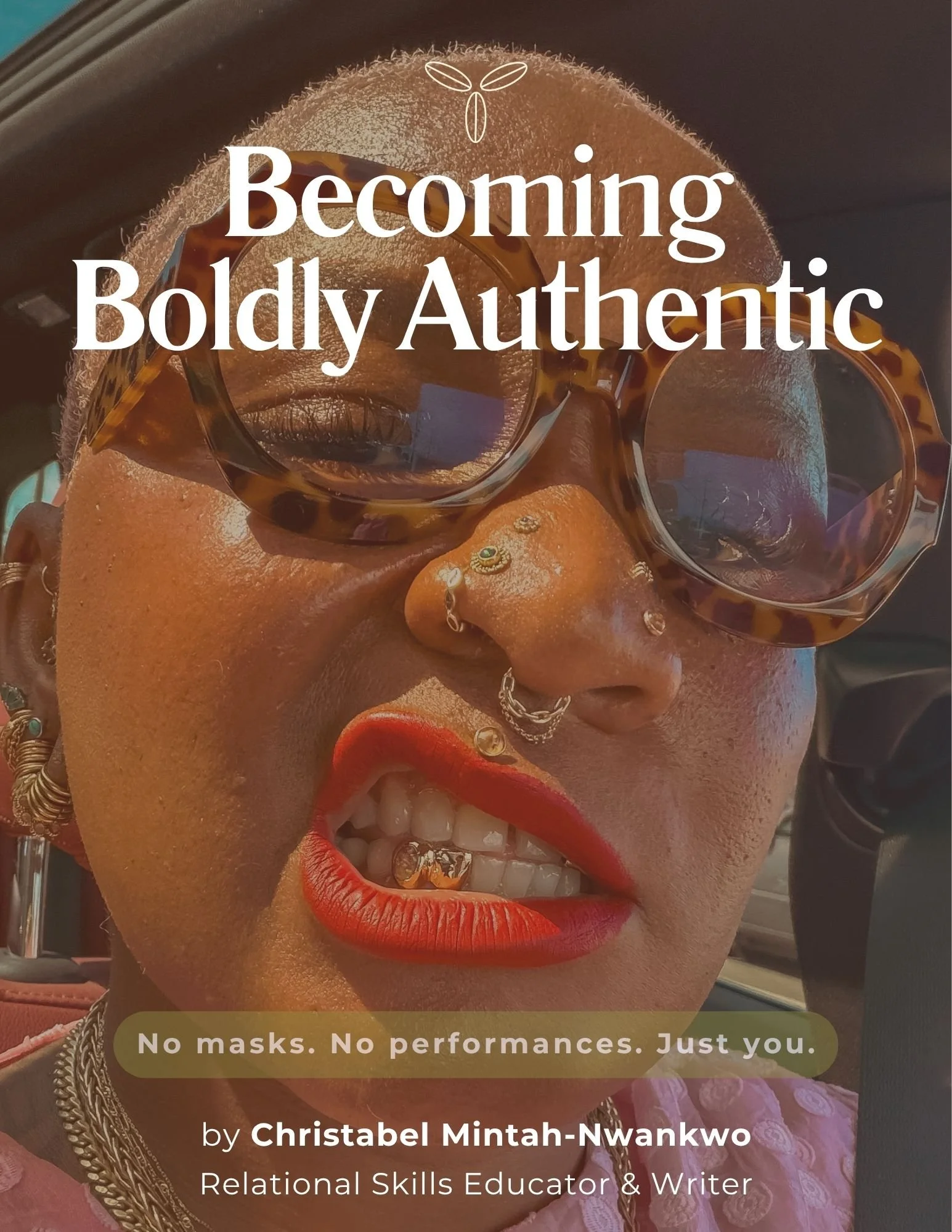
Becoming Boldly Authentic is a six-module workbook for recovering your capacity for authenticity that conditioning, religion, culture, and relational training interrupted.
Instant PDF download · 110 pages
3,238 people took the Relational Skills Quiz. Here is what they said in their own words.
people chose "I just want everyone to be okay" as the phrase that hits closest to home.
"I would stop performing and let people see the real me."
"I would let myself lean on others and actually be held."
"Receiving care without feeling like I need to earn it."
"You want to be vulnerable. You just don't know how without oversharing."
These are not vague aspirations. These are specific, ordinary things: the desire to stop holding yourself back in rooms where you are technically safe, to ask for something without feeling like a burden, to let someone see you struggle without immediately reassuring them that you're fine. This is what the performance actually costs. The slow and steady accumulation of the quiet version of yourself.
You know this. You have probably said a version of this out loud to a therapist or a close friend. And yet last week you still sent the "no worries" text when you were actually worried. You still said "of course" when you meant "I can't right now."
The crinkled paper.
There was a congregation elder who used a piece of paper to explain sinfulness to a room full of children. He crumpled it, tried to smooth it back out, then showed us the residual wrinkles. That is us, he said. We were born crinkled, and if we stay close and obedient, maybe one day you will be smoothed back out.
I listened to variations of that talk three days a week until I was twenty-eight years old.
That illustration was not theology. It was a technology of erasure. Tell a child they were born wrong and they will spend their entire life performing their way into acceptability. They will flatten themselves into whatever shape the room requires and call that love, obedience, and ultimately, who they are.
Bold Authenticity is not a personality trait you develop. It is a capacity that is systematically interrupted by colonial inheritance, religious conditioning, cultural legacy burdens, and systems that need you to be manageable. From your family, to your congregation, your HR department, and your social media algorithm. All of them running the same logic: smooth yourself out. Stay acceptable.
I wrote this workbook because I needed it and still do.
Last month, putting together our wedding guest list, I caught myself wanting to invite people I don't have a real relationship with, because I didn't want them to feel left out. The pull was quiet and familiar, the don't-disappoint pull, the keep-everyone-okay pull.
I caught it, named it, and talked it over with my friends. I held myself to account using the same framework I built for you. That is the practice.
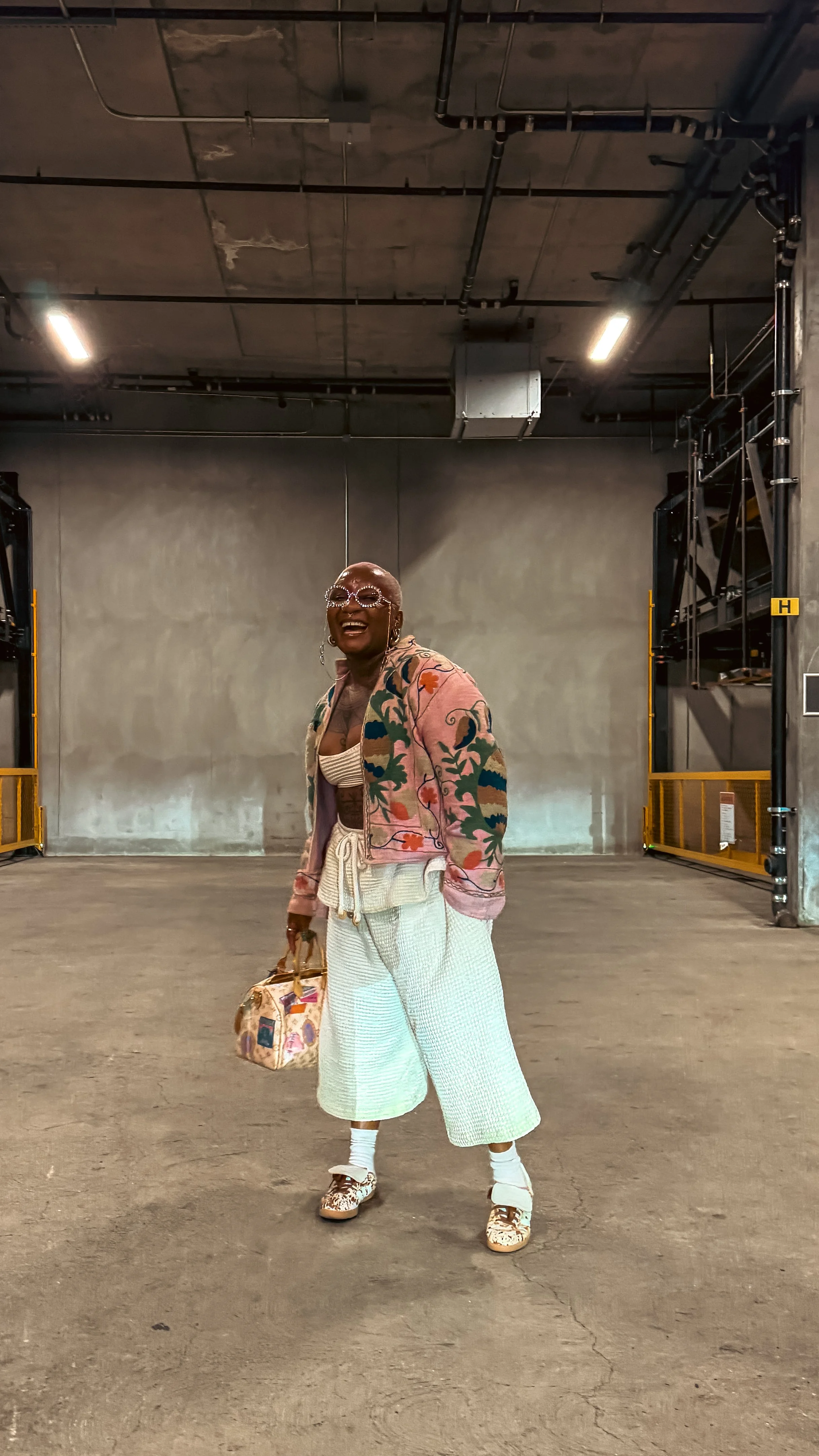
I grew up in a third-generation Jehovah's Witness household in Ghana and Nigeria. A system that required compliance from the time I could understand language. I came out as queer at twenty-eight and lost my entire social infrastructure in a single season, every friendship I had built over a decade, gone. I have been building relational skills from scratch ever since as a survival strategy and a political practice.
I left nursing to do this work full-time because I spent years watching people arrive in hospital beds, dying alone because they had spent their lives cultivating empty friendships that did not know them enough to show up for them. I know what the absence of this work costs.
I did not build a mere theoretical framework. I mapped the territory I walked through myself, drawing on my 14 years as a nurse and 40 years as a human, determined to show up fully myself.
- Relational skills educator, writer, full-time since 2026
- Former nurse leader, team of 84 in a high-trauma hospital setting
- Nearly 6,000 RSL workbooks sold
- 180K+ community members across platforms
- The goal is not to be me. The goal is to be you.
Six modules. Each one moves you forward.
Becoming Boldly Authentic is not a journal or a reading guide. It is a set of practices including exercises, reflections, scripts, and frameworks. You bridge the gap between what you know and how you live, one degree at a time, in your real life with real people. Expect practical skills, tangible shifts, and readiness to act authentically.
Before you can change the performance, you have to map what you have been performing and whose voice installed it. You audit the cultural legacy burdens, identify your true values, and distinguish what was handed to you from what remains intact. By the end, you will have clear insight into the roots of your choices and your authentic values.
This module helps you trace why you disappear yourself and reveals the three conditions that produce performance: conditional love, punishment for visibility, and vicarious erasure. You learn where contextual adaptation ends and self-erasure begins. You gain practical tools, such as the Three-Part Apology to Self, and learn to treat others' upset as information instead of a verdict.
The gap between knowing and doing is where most people live. This module provides daily practices to bring your intentions to life. You perform an Integrity Audit across domains and learn the "I notice" practice, enabling you to consistently act on your real truth in everyday moments.
Your body is political territory. Purity culture appears in many forms, in the workplace, family, and on social media. This module identifies these forms and teaches you to reclaim your style as a form of sovereignty. You gain tools to inhabit your body authentically, treat personal expression as heritage, and build lasting confidence.
Internal work needs an external witness. This module explains how to be known without emotional flooding. It covers calibrated truth-telling, the space between oversharing and shutting down. Repair work and justice work are not the same. Mixing them can be costly. Learn to build a chosen family if your family cannot support you.
Bold authenticity is not a destination. It moves through seasons — growth, stuckness, breakdown, and integration. This module gives you rhythms to sustain the practice long-term. Learn about your seasons so stuckness does not feel like failure. Financial independence is another kind of freedom: money and authenticity connect.
Inside, you'll find six modules packed with practice tools, not theory. This workbook is designed for repeated use, so you can revisit it again and again, instead of setting it aside after a single pass.
PDF · Works on any device · Print the reflection pages if you write by hand
The pattern doesn't dissolve because you understand it.
It dissolves because you deliberately practice new behaviors, again and again, until your true response is easier than the old pattern. Simply knowing what to do isn't enough; action, in real moments, is what actually creates change.
Without the practice:
- Friendships keep ending when people realize they've been relating to a version of you that isn't quite true, and the cycle repeats with someone new who also gets the performance version.
- You keep being in rooms full of people who like you and feel the specific, expensive loneliness of being surrounded but not known.
- You keep saying "no worries," "of course," "I'm fine," and feeling the consistent slow erosion of it.
- Every guest list, salary negotiation, difficult conversation, and family dinner is governed by who you're afraid to disappoint, not by what you actually want.
- You keep knowing exactly what you're doing and freezing in the moment anyway, and then adding it to the growing list of evidence that something is wrong with you.
The most expensive version of this is not dramatic. You can build a full life, career, relationships, and community, while being nearly entirely unknown within it. Because from the outside, everything looks fine.
This isn't about instant transformation. It's about steady practice, real change, one move at a time, lived out in your daily life.
The goal isn't to become a fixed, flawless self. The aim is to notice the urge to perform sooner, use a reliable framework when it arises, and let trusted people support you as you work through it.
The cycle of friendships ending because you discover you're a different person than they got to know becomes less frequent. Because the people who find you now are finding the actual version. You can show up in your messiness and your in-between, in the places where you're still figuring it out, and have people who truly mirror you and hold you through your becoming.
I started with tiny tattoos. A butterfly, a small portrait of my dog, because I was terrified of what my mother would say. I thought, oh, the chances of not upsetting her would be lower if the tattoos were "pretty." She hated them anyway. She threw the remote at me when she saw the tongue ring, called on Jehovah, the whole thing. And I had a realization: if she is going to hate the butterfly, I might as well do exactly what I want. Because people who require the performance will always need more of it. There is no version of compliance that is ever enough. At some point, you make peace with that. And then you get the blackout sleeves rooted in your ancestral heritage, because that is what you actually wanted all along.
It might sound like rebellion, but it's far from it. Rebellion is doing it despite them, in their face, to prove a point. I'm talking about doing it because that is what you want. Because that is how you exit this world empty, knowing you showed up fully.
That is how people change around you, not through explicit instruction, but through permission. When my fellow nurses look at me and say, "Christabel is so herself, which means I can dare to be myself", that is the work moving outward and the political project. Not just your liberation, but what it makes possible for the people around you who are watching to see if it's survivable.
There are people who cannot afford to show up as freely as some of us can, trans people, neurodivergent people, people whose safety is more precarious than ours. When you use your privilege to show up fully, you become a safe harbor for them. The work is never only personal.
None of us heals alone. I didn't. I share these tools because connection heals, isolation does not.
After doing the work.
"Your posts helped me understand why I felt I needed to be independent. I was sick of the American hyper-independence narrative. And then I got cancer. And I wonder how I ever thought I'd survive alone."
"I repaired a friendship I thought was gone. I didn't think repair was available to someone like me. This work showed me it was a skill I could learn."
"I've been in many spaces where I thought I had to suppress parts of myself. This workbook puts onto paper the feeling and thought about collective repair that I could never name. I use it in the healing circles I facilitate."
"I have a Zoom date with a friend I haven't talked to since 2017. I credit your content for what I unlearned about what relationship is supposed to cost."
"As a neurodivergent person, I feel very seen. The discomfort in this work is named honestly. People confuse their discomfort but that's part of their workload, not mine."
"A brilliantly beautiful and accessible workbook. Essential tools for relational skills."
"Really powerful. Simultaneously clear-cut in writing but able to guide you to go deep. Context with real-world steps."
"I realized the relationships built on my silence were never real to begin with. This work taught me how to come back to myself — and to others — with courage."
And who it is not.
- "I just want everyone to be okay" hit you somewhere specific when you read it
- You said "no worries" this week when you were not fine
- You replayed a difficult conversation trying to figure out what you did wrong — before anyone told you that you did
- You've been in therapy, done the reading, can explain your patterns, and still freeze in the actual moment
- You grew up in a system that required your compliance — high-control religion, love that was conditional on usefulness, a culture that needed you manageable
- You want to stop performing and let people see the real you — and you need more than the concept. You need practice tools.
- You are ready to treat bold authenticity as a political project, not a personal development hobby
- You want affirmations and motivational content. This is excavation work. It asks difficult things of you.
- You want a shortcut around the internal work. There is not one. There is only the practice.
- You expect a single read-through to change your patterns. Pattern change requires repetition. This workbook is designed to be returned to.
- You haven't yet done the foundational RSL framework work. Start with the Toolkit — it's the full map. This workbook goes deep on one pillar of it.
- You are seeking therapy. This workbook is a practice tool, not a substitute for professional mental health support.
The RSL framework has four pillars. This workbook goes deep on the first one.
You cannot build love-centered boundaries without a self to build from. You cannot repair a rupture while performing. You cannot be in genuine interdependence if the version of you who shows up is a performance. Bold authenticity is the foundation. Everything else is built on it.
Answered honestly.
I've been in therapy for years. I understand why I do this. Do I still need this?
Therapy clarifies the 'why.' This workbook offers actionable steps for in-the-moment change: specific phrases, practical exercises, and scripts for when you freeze and automatic responses take over. Many gain insight in therapy but lack tools for immediate change. This workbook fills that gap. They often complement each other.
I've been successful being this version of myself. It's been rewarded. Why change it?
Because the version that earns rewards is often the one that minimizes others' needs. Eventually, you recognize your achievements — your career, relationships, reputation — are real, but your inner self remains undefined. This workbook won't diminish your success. It will help you truly know the person living your life.
I'm afraid I won't recognize myself after I do this work.
This is a genuine fear and deserves a thoughtful answer. You won't become unrecognizable. You'll gain clarity about what belongs to you and what was shaped by outside influences. Some parts you'll retain, others you'll let go. You're not starting anew. You're reconnecting with what's always been yours.
I don't have a religious background. Is this still relevant?
Religious conditioning is one origin of this distorted logic, but not the only one. Culture, family, gender roles, institutions, and algorithms shape it, too. If you learned to adjust yourself to maintain acceptability, this workbook is for you.
I'm neurodivergent. Will this work for me?
Yes. This workbook considers neurodivergence and chronic illness, especially in sections on shame, self-trust, and the body. You can repeat the exercises at your own pace, not all at once.
How long will this take?
That's not the right question. The workbook isn't meant to be finished in one read. Instead, ask: how long will you practice? Most spend 30–60 minutes per module at first, then revisit exercises over time. Module 6 rhythms are ongoing.
Is there a refund policy?
As this is an instant-access digital product, all sales are final. If you have any questions before purchasing, please contact me at christabelmintahgalloway.com.
You are not the crinkled paper.
You were never the crinkled paper.
The workbook does not promise you transformation. It promises you practice. One degree at a time. In real conditions. With the real people in your actual life.
Instant PDF download · 110 pages · Six modules